.AHLogo1200x1200Black-07578d9b18173fee3d04bf845fdf5007eba8c3c451a934328392e5221830e241.png)
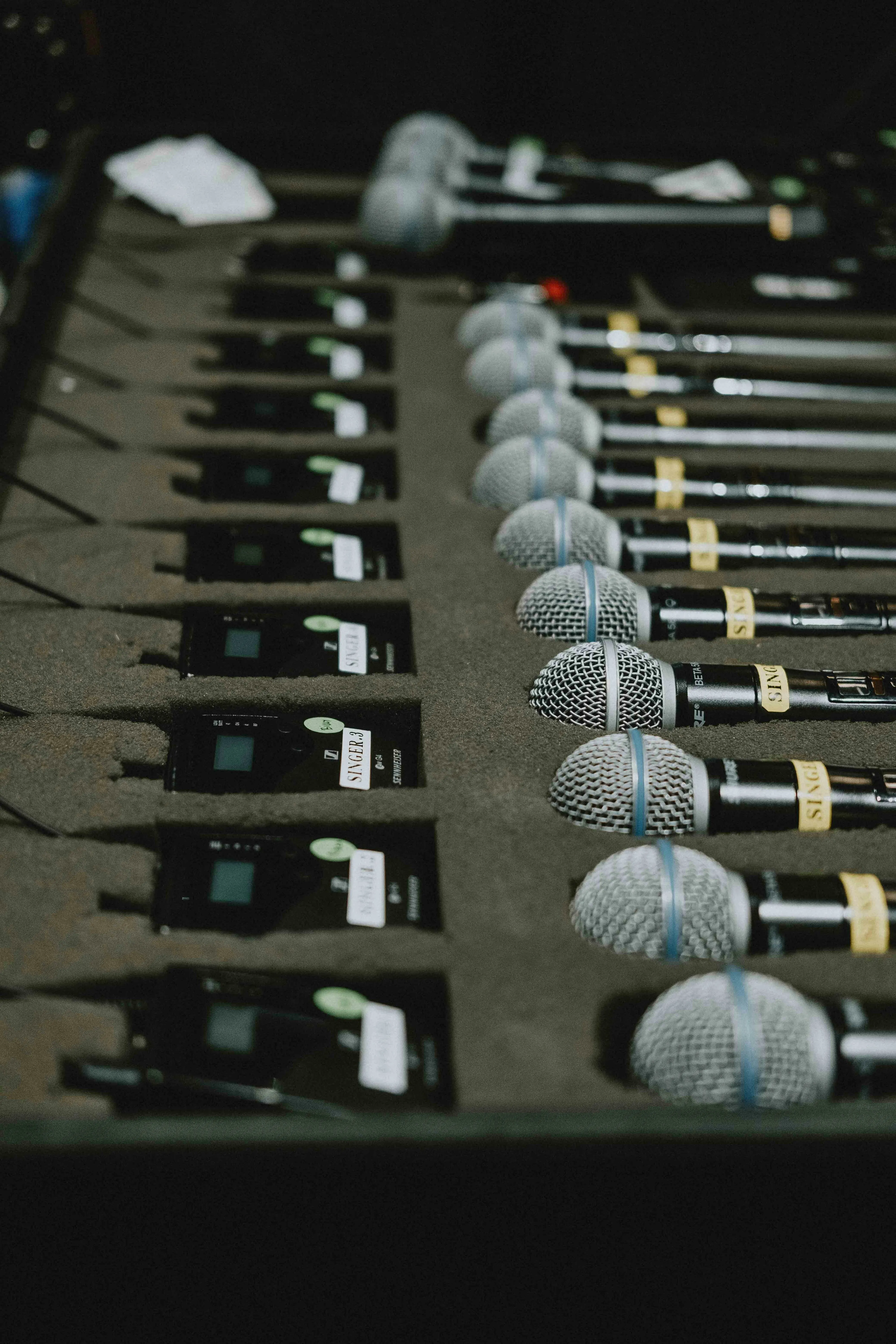
Microphone planning becomes more complicated when several people need to speak during the same programme. A single presenter delivering a prepared speech may have a straightforward requirement, but a panel discussion, conference session or audience Q&A introduces questions about how many people need to speak simultaneously, whether microphones will be shared, how quickly conversations need to move and who will control the equipment.
There is no useful rule that says a conference with a particular number of guests requires a particular number of microphones. The audience size influences the overall PA system, but microphone quantity is primarily determined by the format of the programme. A 300-person presentation with one speaker may have a simpler microphone requirement than a 50-person panel involving six panellists, a moderator and audience questions.
The best approach is therefore to work through the programme before counting microphones. Identify everyone who needs to speak, whether they need to speak simultaneously, where they will be positioned and how much movement is involved. Once those questions are answered, the required microphone quantity usually becomes much clearer.
Start With the People Who Need to Speak
For a conventional presentation, one microphone may appear to satisfy the basic requirement because only one person is scheduled to speak at a time. In practice, it is worth considering the complete programme. There may be an MC introducing speakers, several presenters rotating through the stage, an awards component or questions from the audience. Each of these can change how the microphones need to be allocated.
A panel discussion is different because conversation needs to flow naturally between several people. Passing one microphone continually along a row of panellists can interrupt that flow, particularly when participants respond quickly to one another. The more conversational the session, the more useful it becomes for speakers to have ready access to microphones rather than waiting for one to reach them.
That does not necessarily mean every person involved in a conference requires their own microphone for the entire day. A microphone used by one presenter can potentially be used by another presenter in the following session. The distinction is between people who need access to microphones at the same time and people whose requirements occur at different points in the programme.
The moderator also deserves separate consideration. During a panel, the moderator may need to introduce participants, ask questions, redirect the discussion and intervene while another panellist has a microphone. Giving the moderator independent access to a microphone can make the conversation considerably easier to manage.
The same principle applies to an MC. If the MC is responsible for moving the programme between speakers, it can be inefficient to take their microphone away every time another person needs to speak. Thinking in terms of roles rather than simply counting people produces a more practical microphone plan.
Panel Discussions Need to Allow Conversation to Flow
A panel discussion should sound like a conversation, even when it is being reproduced through a PA system. If participants are constantly waiting for a microphone to be passed between them, the technology begins to dictate the pace of the discussion.
For a small panel where contributions are relatively formal and sequential, sharing microphones may be workable. If the moderator asks a question and each panellist answers in turn, there may be enough time for microphones to move between speakers without becoming distracting. A more spontaneous discussion, however, benefits from greater microphone availability because participants can respond naturally.
The physical layout matters as well. Panellists seated closely together can share microphones more easily than participants positioned across a wide stage. If tables, lecterns or other furniture separate speakers, passing microphones becomes less convenient. A microphone on a stand may be appropriate in some fixed positions, while handheld microphones provide greater flexibility in others.
The number of microphones also needs to be considered alongside the mixer. Every microphone that needs to operate independently requires an appropriate input into the sound system. Adding microphones without considering the available inputs and how those channels will be controlled can create a system that looks complete on paper but cannot be operated properly.
Microphones that are not being used at a particular moment may also need to be managed. An open microphone can pick up conversation, handling noise, movement on stage and sound from the loudspeakers. As the number of open microphones increases, managing the complete system becomes increasingly important. For larger or more complex discussions, having someone actively operate the audio system can therefore be valuable.
Audience Questions Change the Microphone Plan
Question-and-answer sessions often reveal a weakness in microphone planning. The stage microphones have been considered carefully, but nobody has decided how a person sitting halfway across the room will ask a question that everyone else can hear.
In a small room, it can be tempting to let audience members simply speak loudly. That may allow the presenter to hear the question, but it does not mean the rest of the audience can understand it. It can also create problems where a presentation is being recorded or streamed because the question may not be captured properly.
A microphone dedicated to audience questions provides a more reliable solution. A wireless microphone can be particularly useful because it can move through the audience without requiring an XLR cable to be run between rows of chairs. Someone can carry the microphone to the person asking the question, or it can be passed between audience members where the layout makes that practical.
For larger audiences, more than one Q&A microphone may be appropriate. If a single microphone has to travel from one side of a large room to the other after every question, substantial pauses can develop. Two roaming microphones can allow the next question to be prepared while the current person is speaking.
Someone should also take responsibility for the Q&A microphones. Audience members unfamiliar with microphones commonly begin speaking before the microphone reaches them, hold it too far away or lower it while continuing their question. A staff member, technician or organiser who carries the microphone and helps position it can improve intelligibility considerably.
Our microphone technique guide explains why microphone distance and handling matter. For audience questions, the essential instruction is simple: wait for the microphone, keep it reasonably close to the mouth and speak normally.
Wired and Wireless Microphones Can Work Together
There is no requirement for every microphone in a conference or panel system to use the same format. In many cases, combining wired and wireless microphones produces a more practical arrangement than deciding that the entire production must be one or the other.
A microphone at a fixed lectern or presentation position may have no need to be wireless. A wired Shure SM58 or another appropriate microphone can provide a straightforward connection using an XLR cable. Where the speaker remains in one place, the cable creates little practical disadvantage.
A moderator, MC or presenter who needs to move around the room may benefit much more from wireless operation. Audience Q&A is another obvious application because the microphone needs to travel to the person asking the question. The decision should therefore follow the role of each microphone rather than an assumption that wireless equipment is automatically more professional.
Wireless systems also introduce additional considerations. Receivers need to connect to the audio system, transmitters require suitable batteries and the complete wireless setup needs to be checked before the programme begins. The benefit is freedom of movement, so that benefit should solve a genuine requirement.
Our wired versus wireless microphone guide explores this decision in more detail. For a conference, the practical question is usually straightforward: which people need to move, and which microphones can remain in fixed positions?
Plan the Complete Audio System, Not Just the Microphones
A conference with multiple microphones needs enough mixer inputs for the required sources. If the programme also includes music playback, video audio, laptops or other sound sources, those inputs need to be considered as well. It is much easier to establish this before the equipment is booked than to discover during setup that the system cannot accommodate everything required.
The loudspeaker system also needs to provide appropriate coverage for the audience. Increasing the number of microphones does not solve poor coverage, and increasing microphone gain to compensate for audience members who cannot hear can make feedback more difficult to control. The microphones, mixer and loudspeakers need to operate as one system.
Audio Hire's PA hire in Adelaide and sound system hire provide starting points when the microphone requirement forms part of a complete audio setup. For corporate functions and presentations, it is worth considering the room dimensions and audience layout as well as the number of attendees.
Practical infrastructure matters too. Wired microphones require appropriate XLR cables. Powered audio equipment may require extension leads, while cable covers can be useful where appropriate cable routes cross areas used by delegates, presenters or venue staff. Wireless receivers, mixers and playback equipment all need suitable locations where they can be connected and operated.
Testing should include the programme scenarios that will actually occur. If the moderator and several panellists will speak during a discussion, test the system with multiple microphones in operation. If audience Q&A is planned, walk the wireless microphone through the audience area and confirm that it works where it will actually be used. A test conducted entirely beside the equipment does not reproduce the conditions of the conference.
Work Backwards From the Programme
The simplest way to calculate microphone requirements is to create a basic running order and work through it. Note who is speaking during each part of the programme, whether anyone else needs immediate access to a microphone and whether questions will come from the audience.
A conference might begin with an MC, move to a keynote presenter, continue with a multi-person panel and finish with audience questions. The maximum microphone requirement may occur during the panel rather than the keynote, so planning only around the principal presenter would underestimate what the production needs.
Conversely, not every speaker appearing during the day necessarily needs a dedicated microphone. Presenters appearing at different times can often use the same equipment. The objective is not to maximise the microphone count; it is to ensure the programme can proceed naturally without people waiting unnecessarily for equipment or being unable to participate when required.
For a broader introduction to microphone selection, read Microphone Hire for Events: A Complete Guide to Choosing the Right Microphone. You can also browse current equipment through Microphone Hire Adelaide.
If you are unsure how many microphones a panel, conference or Q&A session requires, tell Audio Hire how many panellists and presenters are involved, whether there is an MC or moderator, whether audience questions are planned and how the room will be arranged. Those details are considerably more useful than the audience number alone when working out an appropriate microphone setup.