.AHLogo1200x1200Black-07578d9b18173fee3d04bf845fdf5007eba8c3c451a934328392e5221830e241.png)
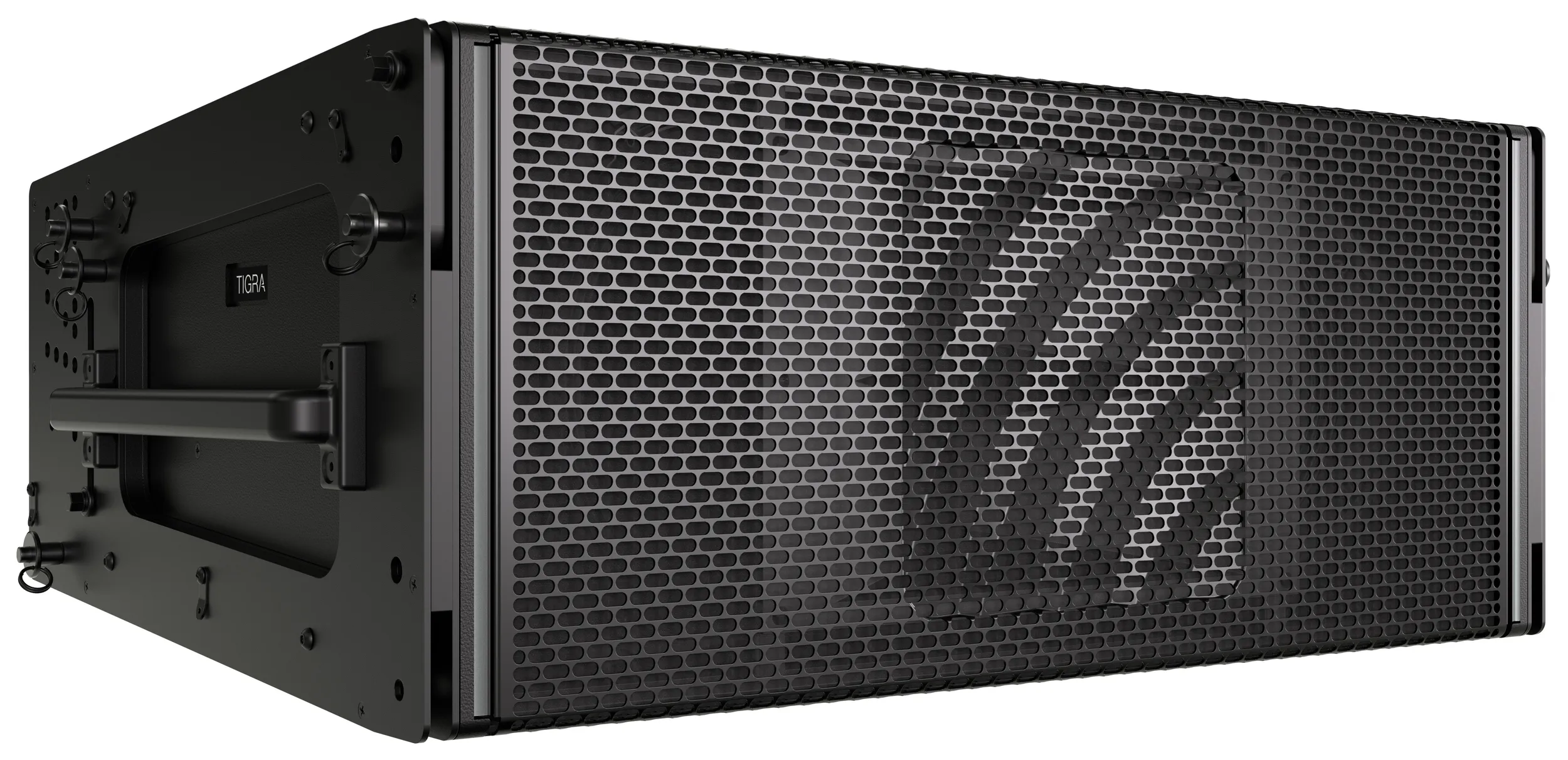
Meyer Sound Tigra is a compact, self-powered professional line-array loudspeaker designed to bring the performance, control and system integration associated with larger production systems into a more practical format. Introduced in 2026, Tigra combines high output, controlled coverage, integrated amplification and processing, and Meyer Sound's GEN-1 technology in a system designed for a wide range of professional applications.
For someone organising a wedding, corporate function, gala dinner, presentation or live performance, however, the important question is not simply what Tigra can do on a specification sheet. What matters is how those capabilities can contribute to clearer speech, well-controlled music reproduction and more consistent sound throughout the audience area.
This guide looks at Tigra from that practical perspective: what it is, how a Tigra line array works, what its specifications mean, how Meyer Sound's self-powered and GEN-1 architecture affects system design, and why professional deployment remains important.
What Is Meyer Sound Tigra?
Tigra is a professional line-array loudspeaker system from Meyer Sound. Rather than operating as a single conventional loudspeaker, multiple Tigra elements can be combined into an array whose configuration is designed around the audience and the space.
Meyer Sound introduced Tigra in March 2026 alongside the 1800-LFC Low-Frequency Control Element. The two products extend technologies and design principles used across Meyer Sound's professional loudspeaker systems into new, comparatively compact formats.
This is an important distinction because compact does not mean that Tigra is simply a portable PA speaker in a different-shaped enclosure. It remains a professional system-design product. Meyer Sound identifies applications including theatres, performing arts centres, ballrooms, sports facilities, houses of worship and other professional environments. Tigra can be flown or ground-stacked and can serve in different system roles depending on the design.
For Audio Hire, the practical significance of Tigra is its suitability for occasions where sound quality, coverage, presentation and technical operation are important. This can be particularly relevant to corporate functions and weddings, where the sound system may need to move between intelligible speech, background music, presentations and considerably more dynamic programme material later in the occasion.
A corporate function, for example, might begin with microphones and presentations before moving into entertainment. A wedding reception can move from speeches and formalities into a full dance floor. The loudspeaker system therefore needs to be considered as part of the complete production rather than selected solely according to how loud it can become.
How a Tigra Line Array Controls Sound
One of the most important things to understand about Tigra is that its value lies not simply in the individual loudspeaker, but in what happens when multiple elements are configured as a system.
A line array uses a series of loudspeaker elements arranged to work together. Their physical position, the angles between them, the height and position of the array and the processing applied to the system all contribute to the resulting coverage.
This gives a system designer tools for addressing one of the fundamental challenges in sound reinforcement: delivering appropriate sound to people at different positions within an audience.
Consider a long ballroom. People near the sound system and people at the back of the room are listening from very different distances. Simply increasing the level in an attempt to reach the back can make the experience unnecessarily loud for people closer to the system. It can also increase the amount of acoustic energy interacting with reflective surfaces within the room.
A line-array system provides a more sophisticated way of approaching that problem. Rather than treating output as the only variable, the system can be configured around the shape and depth of the audience.
Tigra has been designed with flexible deployment in mind. Meyer Sound specifies flown and ground-stacked configurations and different potential system roles. This flexibility allows physical deployment to respond to the requirements of the venue rather than forcing every production into the same loudspeaker arrangement.
This does not mean that every application requires a large array, nor does it mean that a line array is automatically preferable to every other loudspeaker format. Array design needs to reflect audience geometry, programme material, venue characteristics and practical deployment constraints.
The important principle is that the loudspeaker system is designed around the listening area.
Self-Powered Design, Headroom and What the Specifications Mean
Tigra follows Meyer Sound's long-established self-powered philosophy. Amplification is incorporated into the loudspeaker and engineered alongside the drivers, processing and other components rather than relying on separately selected external amplifiers.
The significance of this approach is integration. Amplification, drivers and processing can be designed to operate as components of the same loudspeaker system. This is particularly relevant in a line array because consistency between individual elements contributes to predictable behaviour across the complete array.
Tigra's specifications also illustrate why professional loudspeaker performance should not be reduced to wattage.
Meyer Sound specifies a 55 Hz to 16 kHz linear operating range for Tigra. Tigra-L has a specified maximum peak SPL of 146 dB, while Tigra-W is specified at 145 dB. These figures demonstrate substantial capability from a comparatively compact enclosure.
They do not, however, represent target listening levels.
Maximum SPL describes capability rather than how loudly a system should be operated for an audience. In practical system design, available capability contributes to headroom—the margin that allows a system to reproduce dynamic peaks without needing to operate continuously at its limits.
This matters with music because musical signals are highly dynamic. Vocals, percussion and other programme elements can produce short peaks considerably above the average level. A system with appropriate headroom has room to reproduce those peaks while maintaining control.
For corporate applications, sheer output may be far less important than intelligibility and consistency. A keynote address or awards presentation does not need concert-level volume. It does, however, need voices to remain clear across the intended audience area.
At a wedding, the same system may face several different requirements during the course of the reception. Speeches need intelligibility. Background music needs balance and restraint. Later, the dance floor may require considerably greater dynamic capability.
This is why professional loudspeaker specifications are most useful when interpreted in the context of the application. The objective isn't to use all of the available output. It is to have the capability and control necessary to deliver the required result.
Tigra also incorporates controlled cardioid low-frequency behaviour, providing another tool for managing how acoustic energy is distributed by the array.
That can be particularly useful in professional environments where controlling where sound goes is just as important as producing it.
GEN-1 Brings Processing and Connectivity Into Tigra
Tigra incorporates Meyer Sound's GEN-1 input module, integrating digital signal processing and networked-audio capability into the loudspeaker alongside conventional analogue connectivity.
This represents another stage in the evolution of the self-powered concept.
A self-powered loudspeaker already brings amplification into the enclosure. GEN-1 extends that integration by incorporating processing and network capabilities that would traditionally have depended more heavily on external equipment.
Meyer Sound's GEN-1 implementation in Tigra provides Milan networked audio alongside analogue connectivity, with processing derived from the company's Galileo GALAXY platform. Meyer Sound says this integrated architecture can reduce the requirement for separate system processing in suitable configurations.
For an audience, none of this should be particularly noticeable—and that is arguably the point.
Someone listening to wedding speeches should not need to know how the loudspeaker receives its signal. A corporate guest should not care whether audio travelled through an analogue connection or an audio network. The technology exists to give the technician greater control over the system and enable sophisticated professional workflows.
For system designers and operators, however, those capabilities matter. Networked audio allows signal distribution and system architecture to become increasingly integrated, while analogue connectivity remains available where appropriate.
That flexibility allows the underlying system to be designed around the requirements of the production rather than requiring every production to use exactly the same signal path.
Tigra and the 1800-LFC Low-Frequency System
Although Tigra provides substantial full-range capability, applications requiring dedicated low-frequency reinforcement can incorporate Meyer Sound's 1800-LFC Low-Frequency Control Element.
Meyer Sound introduced the 1800-LFC alongside Tigra and describes it as a natural complement to the line-array system. Like Tigra, the 1800-LFC is self-powered and incorporates GEN-1 technology.
The relationship between the two is important.
Adding dedicated low-frequency elements to a professional system isn't simply about producing more bass. It allows different parts of the system to concentrate on different acoustic tasks. Tigra can provide the principal audience coverage while the low-frequency system reproduces the frequencies for which it has specifically been designed.
That becomes particularly relevant for music-led applications. A wedding dance floor, live performance or entertainment programme may contain substantial energy from kick drums, bass instruments and electronic music. Reproducing that material convincingly places different demands on a sound system from an application dominated by speech.
Meyer Sound specifies the 1800-LFC with an operating range extending from 30 Hz to 125 Hz. It can also be deployed in different physical configurations as part of a professionally designed low-frequency system.
For Audio Hire configurations where dedicated low-frequency reinforcement is appropriate, the approach begins with at least two low-frequency elements. Their positioning and configuration are then considered as part of the complete sound system rather than simply placing bass loudspeakers wherever there happens to be room.
This becomes particularly important in venues where low-frequency energy needs to be controlled. Bass interacts strongly with room boundaries, and multiple low-frequency sources interact with one another. Their placement can therefore affect both what the audience hears and how sound behaves elsewhere in the venue.
We explore the 1800-LFC and these principles in greater depth in our dedicated Meyer Sound 1800-LFC guide.
Where Tigra Makes Sense in Real-World Productions
The technical capabilities of a professional line array are only useful if they solve real production problems.
For corporate functions, one of the most important priorities is often speech intelligibility. Presenters, awards hosts, panel discussions and video content all depend on an audience being able to hear clearly. In a ballroom or function space, the challenge may be achieving appropriate coverage without creating excessive level close to the loudspeakers or unnecessarily exciting reflective surfaces.
Tigra's configurable array format gives the system designer tools for approaching those problems systematically. The system can be considered in relation to audience depth, room geometry, loudspeaker position and sightlines rather than simply choosing equipment according to the room's capacity.
Presentation also matters in many corporate environments. AV equipment forms part of the visual environment of a professionally produced function, and Tigra's relatively compact physical format can be valuable where space and sightlines need to be considered alongside acoustic performance.
Weddings create a different but equally interesting set of requirements.
A reception may move through several distinct phases. Guests arrive to background music. Entrances and formalities follow. Speeches require excellent vocal intelligibility. Dinner may call for restrained music reproduction before the room transitions into a much more energetic dance-floor environment.
A professionally operated system can respond to those changes rather than being treated as a fixed-volume appliance for the entire evening.
For larger weddings, gala dinners and formal celebrations, the physical layout can also create coverage challenges. Long rooms, dance floors, staging, tables and sightline requirements all affect where loudspeakers can be positioned and how the audience should be covered.
Live music introduces further demands. Dynamic range, vocals, instruments and low-frequency content can all place significant requirements on the reinforcement system. The system needs both capability and careful technical operation, particularly when multiple microphones and sources are involved.
Outdoor productions introduce another set of variables because there are fewer room boundaries to contain sound and the listening area can be much more extensive. Coverage, system position and low-frequency behaviour therefore need to be considered differently from an indoor ballroom or function room.
These examples illustrate why Tigra should not be thought of as a loudspeaker for one particular type of occasion. It is a professional system-design tool whose suitability depends on what the production needs to achieve.
Why Tigra Still Requires Professional System Design
Perhaps the most important point about Tigra is that sophisticated technology does not eliminate the need for professional judgement.
Before a system is deployed, the audience layout, venue, programme material and production requirements need to be understood. Decisions need to be made about loudspeaker positions, array configuration, low-frequency reinforcement, signal distribution and physical deployment.
The system then needs to be set up and optimised for the actual space.
A technically capable loudspeaker placed badly can still produce a poor result. An array configured without sufficient regard for the audience can distribute sound inefficiently. Excessive level can reduce comfort and intelligibility. Low-frequency elements positioned without considering their interaction can create inconsistent bass coverage.
Professional sound reinforcement therefore combines equipment with system design and operation.
This is why Audio Hire provides Meyer Sound as a professionally designed and operated service rather than treating Tigra as ordinary dry-hire equipment. The objective is not simply to supply loudspeakers. It is to configure and operate the sound system according to the requirements of the occasion.
For some functions, a conventional professional PA system will be entirely appropriate. Meyer Sound becomes relevant where the requirements justify a more deliberately designed and technically operated solution.
That distinction allows the equipment to serve the production rather than making the production serve the equipment.
Understanding Tigra as Part of a Complete Sound System
Tigra is a useful example of how modern professional sound reinforcement has evolved.
The loudspeaker combines drivers, amplification, processing and connectivity. Multiple elements can form arrays designed around audience coverage. GEN-1 extends processing and network capability into the loudspeaker, while dedicated low-frequency elements such as the 1800-LFC can become part of a broader system designed around the programme and venue.
Yet the fundamental objective remains remarkably straightforward: people need to hear clearly.
For a corporate audience, that may mean understanding every word of a presentation without the sound becoming intrusive. At a wedding, it may mean clear speeches followed later by music with the headroom and low-frequency capability appropriate for a dance floor. For live performance, it may mean reproducing vocals and instruments clearly while achieving useful coverage throughout the listening area.
Tigra provides the system designer with sophisticated tools for achieving those outcomes, but the quality of the final result depends on how those tools are used.
That is why understanding Tigra means looking beyond specifications. Output, frequency response, GEN-1, self-powered amplification and array configuration are all important, but they are components of a larger process: designing sound around the audience, venue and programme.
For a broader introduction to these principles, read Meyer Sound Speaker Systems: An Introduction to Professional Sound Reinforcement.
To discuss Meyer Sound for a wedding, corporate function or other professional production in Adelaide, visit Meyer Sound Hire Adelaide.