.AHLogo1200x1200Black-07578d9b18173fee3d04bf845fdf5007eba8c3c451a934328392e5221830e241.png)
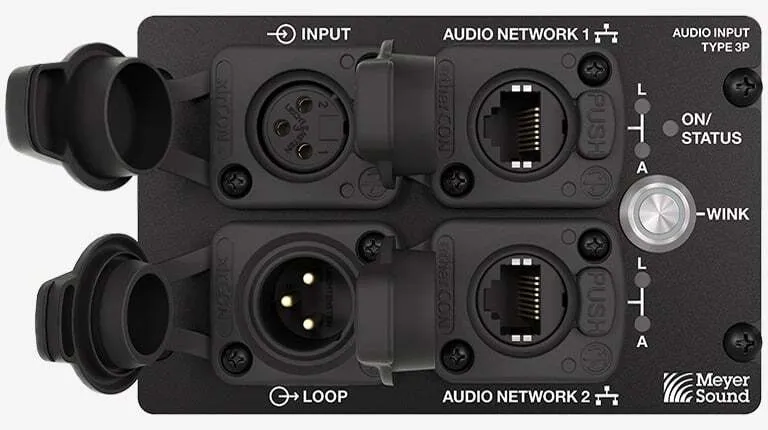
Modern professional sound systems are increasingly built around more than loudspeakers, amplifiers and audio cables. Processing, networking, monitoring and system control have become important parts of the overall design, particularly as productions become more complex and sound systems need to operate reliably across different venues and applications. Meyer Sound's GEN-1 technology brings many of these functions directly into the loudspeaker itself.
For decades, Meyer Sound has been closely associated with self-powered professional loudspeakers, where amplification is integrated into the loudspeaker and engineered as part of the complete system. GEN-1 develops that philosophy further. Instead of the loudspeaker simply containing its own amplification, it can also contain sophisticated signal processing, networked-audio connectivity and monitoring capabilities that previously depended more heavily on external equipment. Meyer Sound describes this progression as moving from self-powered to self-processed loudspeakers.
Tigra incorporates a Type 3P GEN-1 input module, while the 1800-LFC also incorporates GEN-1 technology. This means the principal components of Audio Hire's Meyer Sound system share a modern approach to processing and connectivity. For the person attending a wedding, corporate function, gala dinner or live performance, much of this technology remains invisible. For the technician designing and operating the system, however, it can significantly change how audio is distributed, processed, monitored and controlled.
Understanding GEN-1 therefore requires looking beyond the connections on the rear of a loudspeaker. Its significance lies in the way Meyer Sound is integrating functions that once occupied separate parts of the signal chain into the loudspeaker system itself.
From Self-Powered to Self-Processed Loudspeakers
A traditional professional PA system can involve several separate stages. An audio signal leaves the mixing console, passes through processing equipment, travels to amplification and is then delivered to passive loudspeakers. More sophisticated systems can add further processors, network interfaces, monitoring equipment and additional signal-routing hardware. Each component can perform an important role, but together they can create a substantial technical infrastructure.
Meyer Sound's self-powered approach already changes part of this architecture by integrating amplification into the loudspeaker. The amplifier and loudspeaker components can therefore be engineered as a complete system rather than requiring an operator to select and match separate amplifiers to passive enclosures.
GEN-1 takes another significant step by incorporating Galileo GALAXY-class digital signal processing directly into compatible loudspeakers. Meyer Sound states that this integrated processing can reduce or eliminate the need for separate upstream system processors in appropriate configurations. With Tigra, for example, the GEN-1 module provides onboard processing together with Milan AVB digital audio and conventional analogue audio connectivity.
The important idea is integration rather than simply reducing the number of boxes in an equipment rack. Processing closer to the loudspeaker allows the loudspeaker to become an active part of the system architecture. Instead of receiving an already processed signal and reproducing it, the loudspeaker itself can participate in processing, control and monitoring.
This does not mean that every production suddenly requires a complex digital audio network. One of GEN-1's strengths is that it retains conventional analogue connectivity. A system can therefore be configured around the requirements of the particular production rather than forcing every application into the same technical architecture.
For a straightforward function, an analogue signal path may be entirely appropriate. A more complex production can take advantage of networked audio and more sophisticated monitoring and control. The technology provides options without making complexity an objective in itself.
Milan, AES67 and the Move to Networked Audio
One of the major changes occurring in professional audio is the movement from systems where every audio signal depends on a dedicated analogue cable towards systems capable of transporting multiple audio channels across digital networks.
GEN-1 is designed to operate within that environment. Meyer Sound's GEN-1 platform integrates networked audio alongside analogue connectivity, and the 1800-LFC supports Milan, AES67 and analogue signal paths. Tigra's GEN-1 implementation provides Milan AVB and analogue audio inputs.
Milan is a professional networked-media protocol built on AVB technology. In practical terms, it allows compatible professional audio equipment to exchange digital audio and related information across an appropriately designed network. Meyer Sound's GEN-1 products are Milan-certified, allowing them to form part of compatible Milan systems without requiring audio to be repeatedly converted between unrelated network formats.
For someone organising a function, the details of the networking protocol are rarely important. What matters is what the technology allows the production team to achieve. Networked audio can simplify signal distribution in appropriate systems, provide greater flexibility in routing and reduce dependence on conventional point-to-point analogue signal paths.
Analogue connectivity remains important because professional productions vary enormously. A corporate presentation in a ballroom does not necessarily need the same network architecture as a larger live production. A wedding reception may have quite different technical requirements again. GEN-1 allows compatible Meyer Sound loudspeakers to participate in modern networked systems without abandoning the familiar analogue connections that remain useful in many situations.
This hybrid capability is particularly valuable during a period when professional audio systems increasingly combine established analogue practices with networked technology. Rather than treating one approach as obsolete and the other as mandatory, the system can be designed around what is appropriate for the production.
The 1800-LFC extends this flexibility further by supporting AES67 as well as Milan and analogue connectivity. Meyer Sound describes the product as being able to operate from simple analogue deployments through AES67 environments to fully redundant Milan configurations with analogue failover.
The result is not simply more ways to connect a cable. It gives system designers greater freedom to determine how audio reaches different parts of a professional sound system.
Processing, Monitoring and Control With Nebra
GEN-1 also changes the relationship between the loudspeaker and the person operating the system. A conventional loudspeaker may receive an audio signal without providing much information in return. A network-connected professional loudspeaker can become a source of operational information as well as a destination for audio.
Meyer Sound's Nebra software provides control and monitoring functions for GEN-1-equipped systems. With Tigra, Nebra can control functions including equalisation, delay, gain, Low-Mid Beam Control and input switching. It also provides access to Remote Product Monitoring telemetry and loudspeaker identification functions.
This ability to receive information from the system is significant. Professional sound reinforcement is not only about configuring equipment before an audience arrives. The system also needs to operate reliably throughout the production. Monitoring provides the technician with greater visibility of what individual components are doing rather than relying solely on what can be inferred from the mix position.
GEN-1-equipped loudspeakers can report system health and status through Nebra. Meyer Sound describes this as allowing loudspeakers to communicate back rather than simply receive audio.
For an audience, the benefit is indirect but important. Guests at a wedding do not need to see system telemetry. A presenter at a corporate conference should not need to think about loudspeaker processing. The technical infrastructure exists so that the operator has better information and control while the audience concentrates on the programme.
Processing within the loudspeaker also provides tools that can be applied to the acoustic design of the system. Delay, gain and equalisation are not simply technical adjustments made for their own sake. They can contribute to the relationship between different loudspeakers, different listening areas and the venue itself.
This reinforces an important principle running throughout the Meyer Sound Knowledge Centre: sophisticated equipment does not replace system design. GEN-1 gives a technician more capable tools, but those tools still need to be applied according to the audience, venue and programme.
What GEN-1 Means for a Complete Tigra and 1800-LFC System
The value of GEN-1 becomes clearer when Tigra and the 1800-LFC are considered as parts of the same professional sound system rather than as individual products.
Tigra can provide the principal audience coverage, with the array configuration designed around the listening area. The 1800-LFC can provide dedicated low-frequency reinforcement where required, with Audio Hire's approach beginning with at least two low-frequency elements. GEN-1 adds an integrated processing and connectivity layer across these components, allowing the system to be approached as a connected technical environment.
This matters because a professional sound system involves relationships between its components. The main loudspeaker system and low-frequency system need to work together. Different elements may require appropriate gain, processing and timing relationships. Signal distribution needs to be reliable, and the technician needs to understand the state of the system during operation.
GEN-1 does not make those requirements disappear. Instead, it moves more of the tools used to manage them into the loudspeakers themselves. Meyer Sound describes GEN-1 as bringing the power of a Galileo GALAXY output into the loudspeaker, creating distributed processing capability while retaining centralised control through its software environment.
The practical significance becomes easier to understand when considering a real production. At a corporate function, the sound system may initially be concerned almost entirely with microphones, presentations and video playback. Clear speech and consistent audience coverage are the priorities. Later, the programme may move to entertainment where substantially greater musical dynamics and low-frequency capability are required.
A wedding can involve an even broader transition. Background music during guest arrival may be followed by entrances, speeches, dinner, formalities and finally a dance floor. The physical sound system remains in the room throughout, but the demands placed upon it change considerably.
Integrated processing and monitoring give the technician tools for managing a professional system through those changing requirements. The purpose is not to make the production unnecessarily complicated. It is to provide appropriate control over a system that may be asked to perform several different jobs during the same occasion.
For more information about the main loudspeaker component, read Meyer Sound Tigra: A Complete Guide to the Professional Line Array.
For the low-frequency component, read Meyer Sound 1800-LFC: A Complete Guide to Low-Frequency Control.
Technology Should Serve the Production
GEN-1 represents a significant development in Meyer Sound's approach to professional loudspeaker systems, but its value should ultimately be judged by what it contributes to the production rather than by the complexity of the technology itself.
Milan networking, integrated GALAXY-class processing, system telemetry and software control are powerful capabilities. Yet none of them changes the fundamental purpose of a sound system. A wedding guest needs to understand the speeches. A conference delegate needs to hear the presenter clearly. Music needs to retain its dynamics and tonal balance. People throughout the intended audience area need an appropriate listening experience.
Good professional audio technology makes achieving those outcomes more controllable and predictable. It should not become the focus of the occasion.
This is particularly important because advanced technology can sometimes create the impression that a system can design or optimise itself. GEN-1 does not remove the need to understand loudspeaker coverage, array geometry, venue acoustics, low-frequency behaviour or programme requirements. The loudspeakers still need to be selected and positioned appropriately, and the system still needs to be designed and operated by someone who understands what it is intended to achieve.
The relationship between technology and professional judgement is therefore complementary. Tigra provides tools for controlling audience coverage. The 1800-LFC provides dedicated low-frequency capability. GEN-1 provides processing, connectivity and monitoring. Meyer Sound's MAPP 3D and Nebra environments provide further tools for system prediction and operation. Together they create a sophisticated technical platform, but the technician still determines how that platform is used.
This is also why Audio Hire provides Meyer Sound as a professionally designed and operated service. The objective is not to supply customers with complicated technology and expect them to determine how it should be configured. It is to use the capabilities of the system appropriately for the venue, audience and programme.
For a deeper explanation of how loudspeaker positioning and array design affect what an audience hears, read Understanding Meyer Sound Tigra Coverage and System Configuration.
For the broader principles behind Meyer Sound professional systems, read Meyer Sound Speaker Systems: An Introduction to Professional Sound Reinforcement.
To discuss a professionally designed Meyer Sound system for a wedding, corporate function or other professional production in Adelaide, visit Meyer Sound Hire Adelaide.