.AHLogo1200x1200Black-07578d9b18173fee3d04bf845fdf5007eba8c3c451a934328392e5221830e241.png)
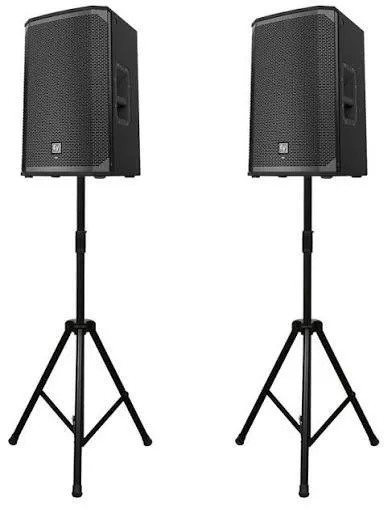
Even a very good PA system can sound disappointing if the speakers are positioned poorly.
Where you put the speakers affects how evenly the sound reaches the audience, how clearly people hear speech and how much risk there is of microphone feedback.
For many events, getting the placement right is more important than simply adding more equipment.
Whether you’re using Electro-Voice speakers for a wedding, corporate presentation, party, DJ event or live performance, there are a few basic principles that will help you get better results.
Put the speakers in front of the audience
The first principle is simple: the main speakers should generally be positioned at the front of the audience area.
The speakers should face the people who need to hear them.
This sounds obvious, but it’s easy to end up with speakers positioned beside, behind or amongst the audience when working in an unfamiliar venue.
Think about the area that needs to be covered and position the speakers so that their output is directed into that area.
Keep speakers in front of microphones
This is particularly important when microphones are being used.
The main speakers should normally be positioned in front of the microphones, from the perspective of the audience.
Putting a microphone in front of a loudspeaker creates a much greater opportunity for the microphone to pick up the amplified sound and feed it back through the system.
That can result in feedback.
Keeping the speakers in front of the microphones helps create a more favourable relationship between the microphone and the PA.
Why speaker stands matter
For many events, full-range speakers should be raised above head height.
A speaker sitting on the floor has a limited line of sight across an audience.
People near the front can block some of the sound from reaching those behind them.
Putting the speaker on a suitable stand raises the acoustic source and allows the sound to travel across the audience more effectively.
This is one reason Audio Hire’s 2 × 1500 Watt 15” Speaker Package includes speaker stands with the two Electro-Voice EKX-15P speakers.
Don’t put the speakers too close together
If you’re using two main speakers, they generally need to be separated enough to provide useful coverage across the audience.
Positioning them immediately beside each other doesn’t necessarily make the system better.
Instead, think about the width and shape of the listening area.
A speaker on each side of the performance or presentation area can provide a useful left-and-right spread.
The exact spacing depends on the venue.
Don’t spread them unnecessarily far apart
The opposite problem can also occur.
If the speakers are positioned extremely far apart, people in the middle of the audience may perceive the sound differently from those closer to either speaker.
The further apart the speakers are, the more important it becomes to consider the listening area and how the speakers are aimed.
The goal is consistent coverage rather than maximum physical separation.
Aim the speakers at the audience
Speaker placement isn’t just about where the cabinets sit.
The direction they’re pointing matters too.
Aim the speakers towards the area where people will actually be listening.
Don’t automatically point them straight ahead if the audience extends at an angle.
For a wide audience, the left and right speakers may need to be angled slightly inward.
For a long, narrow audience, they may need to be aimed further down the room.
The objective is to put the useful output where people are sitting or standing.
Avoid aiming speakers at walls
Hard surfaces reflect sound.
Large walls, windows and other reflective surfaces can send sound back into the room and contribute to a less clear result.
This can be particularly noticeable with speech.
Where possible, position and aim the speakers so that the majority of their output is directed towards the audience rather than directly at large reflective surfaces.
You can’t always avoid reflections, particularly in function rooms, but careful placement can help.
Speaker placement for speeches
Speech is one of the applications where placement makes an especially noticeable difference.
For a wedding, presentation or corporate function, place the speakers towards the front of the audience.
Raise them on stands and aim them across the audience.
Keep the microphones behind the speakers.
This gives the microphone and speaker system the best practical separation.
For a presenter standing at a lectern, the speakers might be positioned either side of the presentation area.
For a wider room, they can be angled towards the audience rather than simply pointing straight ahead.
Speaker placement for weddings
Wedding receptions often involve several different uses of the PA.
There may be speeches, background music and dancing.
During speeches, the priority is clear coverage across the seated audience.
Later, when the dance floor opens, the speaker position may also need to work effectively for the dancing area.
If the same system is being used throughout the evening, consider the entire room when deciding where the speakers will go.
Don’t position the speakers only for dinner if they’ll then be poorly placed for the dance floor.
For more information about choosing an appropriate wedding system, see our guide to wedding audio hire in Adelaide.
Speaker placement for DJs
A DJ setup typically has the speakers positioned on either side of the DJ.
This gives the audience a left and right main speaker and leaves the centre area available for the DJ equipment.
The speakers should be raised so that their output isn’t blocked by people on the dance floor.
If you’re using subwoofers, the arrangement changes slightly.
The main speakers can be mounted above the subwoofers using suitable speaker poles.
Audio Hire’s larger EV speaker and subwoofer system uses this type of configuration.
Speaker placement for live music
For live music, the main speakers should generally be positioned in front of the performers.
This is particularly important because microphones are often used on stage.
Keeping the main PA in front of the microphones helps reduce the risk of feedback.
The speakers should also be positioned so that they cover the audience rather than simply projecting straight out from the stage without consideration for the room.
For a small acoustic performance, this may be relatively straightforward.
For a larger band, stage monitors and additional equipment can introduce further considerations.
Speaker placement for corporate events
For a corporate presentation, the speakers should generally be placed either side of the presentation area and aimed towards the audience.
Raise them above head height where appropriate.
Avoid putting them behind the presenter or directly behind a lectern microphone.
For a panel discussion, the same principle applies.
The panel microphones should remain behind the main speakers from the audience’s perspective.
This helps keep the amplified sound away from the microphone pickup area.
Speaker placement outdoors
Outdoor events can make speaker placement particularly important.
There are fewer walls and ceilings to help reflect sound, so the PA needs to project into the audience area.
Think about the physical depth of the audience.
If people are spread over a long distance, the speakers need to provide useful coverage across that distance.
Don’t simply turn the system up because people at the back can’t hear.
First consider whether the speakers are correctly positioned and aimed.
Speaker placement in a small room
Small rooms present a different challenge.
The audience may be close to the speakers, and reflective walls can be relatively close by.
In this situation, excessive volume can make the room sound harsh or reverberant.
Aim the speakers carefully and use only as much output as the event requires.
For speech-focused events, clarity is generally more valuable than sheer volume.
Speaker placement in a large room
In a large room, the main challenge is often coverage.
You need to get sufficient sound to the back of the room without making the front excessively loud.
This is where simply increasing the volume can become counterproductive.
A larger or more appropriately configured PA may be necessary.
Depending on the venue, additional coverage speakers may also be appropriate.
The system should be designed around the area that needs to be covered.
How high should the speakers be?
For typical full-range event speakers, the horn or high-frequency section should generally be above the heads of the audience.
This helps the higher frequencies travel across the room without being blocked by people standing in front.
The exact height depends on the speaker, stand, audience and venue.
The important thing is to avoid having the speaker’s useful output aimed directly into people’s backs at close range while leaving those further away with less coverage.
What if the speakers are too low?
Low speakers can create uneven coverage.
People close to the speaker may hear plenty of sound while people further back receive a less direct signal.
This can be particularly noticeable with speech.
Raising the speaker on a suitable stand can improve the direct path between the loudspeaker and the audience.
It also helps keep the speaker above people who are standing or moving around.
Where should subwoofers go?
Subwoofers behave differently from full-range speakers.
Low-frequency sound is less directional than higher frequencies, so subwoofers don’t need to be positioned in exactly the same way as the main speakers.
For a typical event setup, keeping the subwoofers near the main speakers is a straightforward approach.
Audio Hire’s larger EV system uses two 18-inch subwoofers with the main speakers mounted above them.
This creates a compact arrangement that works well for DJ and music-focused events.
Should subwoofers be in the middle?
There are different ways to arrange subwoofers depending on the event and system.
For a straightforward hire setup, placing one subwoofer beneath each main speaker provides a practical left-and-right arrangement.
For larger professional productions, subwoofer placement can become considerably more deliberate because low-frequency interaction and coverage across the audience become increasingly important.
The appropriate arrangement depends on the system and venue.
What about the DJ booth?
Try not to hide the main speakers behind the DJ booth.
The DJ booth is not necessarily the acoustic centre of the room.
The speakers should be positioned to provide useful coverage across the audience and dance floor.
The DJ needs to hear the system too, but the primary objective of the main PA is to provide sound for the audience.
What about the microphone?
Microphone position matters just as much as speaker position.
Don’t stand directly in front of a speaker while holding a microphone.
If you’re using a handheld microphone, keep it pointed towards your mouth rather than towards the loudspeaker.
Avoid unnecessarily cupping the microphone grille, as this can also affect its behaviour.
For presenters, explain where they should stand before the event starts.
A few seconds of preparation can prevent a lot of feedback problems.
What causes feedback?
Feedback occurs when sound from a loudspeaker is picked up by a microphone, amplified and sent back through the speaker again.
This creates a loop.
As the gain increases, the system can eventually produce the familiar high-pitched squeal.
Speaker placement is one of the most effective ways to reduce the risk.
Keep the microphones behind the main speakers and avoid pointing microphones directly towards them.
Good gain structure and sensible microphone technique also matter.
Don’t assume more speakers will fix poor coverage
If some people can’t hear properly, adding another speaker isn’t automatically the answer.
First determine why the coverage is poor.
The speakers may be too low.
They may be aimed incorrectly.
They may be too far apart.
The room may simply be too large for the system.
Or the system may genuinely need additional coverage.
The solution depends on the cause.
Speaker placement and room shape
A rectangular room, long narrow hall and wide open room all require different approaches.
For a long room, aim the speakers down the length of the audience area.
For a wide room, the speakers may need to be angled outward or inward depending on their positions and coverage.
For unusual rooms, think about where people will actually be sitting and standing rather than simply placing the speakers symmetrically because it looks tidy.
Sound coverage should take priority over visual symmetry.
A simple Electro-Voice setup
For a typical event using two full-range EV speakers, a straightforward arrangement is:
Left speaker → audience → Right speaker
Raise both speakers on stands, position them towards the front of the audience and aim them into the listening area.
If microphones are being used, keep them behind the speakers.
If the event requires subwoofers, the arrangement can become:
Main speaker → subwoofer → performance area → subwoofer → main speaker
The main speakers can be mounted above the subwoofers where the equipment allows.
Check the setup before guests arrive
Don’t wait until the room is full to discover that the speakers aren’t covering the audience properly.
Walk around the room before the event starts.
Stand at the back.
Stand at the sides.
Sit where guests will be sitting.
Listen to speech and music from different positions.
If one area is noticeably louder than another, adjust the speaker position or aim before simply turning the volume up.
The best speaker position depends on the event
There isn’t one universal Electro-Voice speaker layout.
A wedding ceremony, corporate presentation, DJ event and live band can all require different arrangements.
The basic principles remain the same:
Position the speakers towards the audience.
Raise them appropriately.
Aim them into the listening area.
Keep microphones behind the main speakers.
Avoid unnecessary reflections.
And make sure the system has enough capacity for the area you’re trying to cover.
Need help positioning your speakers?
If you’re hiring Electro-Voice speakers for an event in Adelaide and aren’t sure where they should go, provide the venue details when booking.
A description of the room, approximate audience size and type of event can help determine whether a particular speaker package is appropriate.
Audio Hire can also help you understand the practical setup of the equipment you’re hiring.
You can contact Audio Hire with the details of your event.
Or browse Speaker Hire Adelaide to see the available systems and book online.