.AHLogo1200x1200Black-07578d9b18173fee3d04bf845fdf5007eba8c3c451a934328392e5221830e241.png)
One of the most common questions when planning event audio is: how many speakers do I need? The answer isn’t simply a matter of multiplying the number of guests by a particular number of speakers. The right setup depends on the size and layout of the venue, how many people need to hear the system, what you’re using it for and how much output the event requires.
A corporate presentation for 100 people, for example, has very different requirements from a 100-person party with a DJ. An outdoor event can also require a different approach from an indoor function, even with the same number of guests. The aim is to provide enough coverage and output for the event without hiring equipment that you don’t need.
How many speakers do you actually need?
For most straightforward events, the starting point is a pair of speakers. Audio Hire hires speakers in pairs or larger configurations rather than as individual single-speaker hires. A pair provides left and right coverage and is the normal starting point for a small event sound system.
From there, the appropriate setup depends on the venue and what the system needs to do. A small wedding ceremony, presentation or private function may only require one pair of powered speakers, while a larger event, outdoor space or high-energy music event may require a more substantial system. Two speakers is a starting point, not a universal rule for every event.
Audience size isn’t the only factor
It’s tempting to choose a speaker system based entirely on guest numbers, but this can produce the wrong result. Consider two events with 150 guests. One might be a seated corporate presentation where the audience is concentrated in a single room. The other might be an outdoor party where guests are spread across a large area and music is expected to be played at a higher level. Both events have the same number of guests, but the speaker requirements can be very different.
When choosing a system, consider the audience size alongside the physical space, the required volume, the type of audio and how far the sound needs to travel. The layout of the audience can be just as important as the total number of people attending.
What type of event are you planning?
The purpose of the sound system has a major effect on how many speakers you need. For speeches and presentations, the priority is generally clear and intelligible speech rather than maximum volume. A pair of powered speakers may be suitable for a small or medium-sized presentation, particularly when the audience is seated in a relatively compact room.
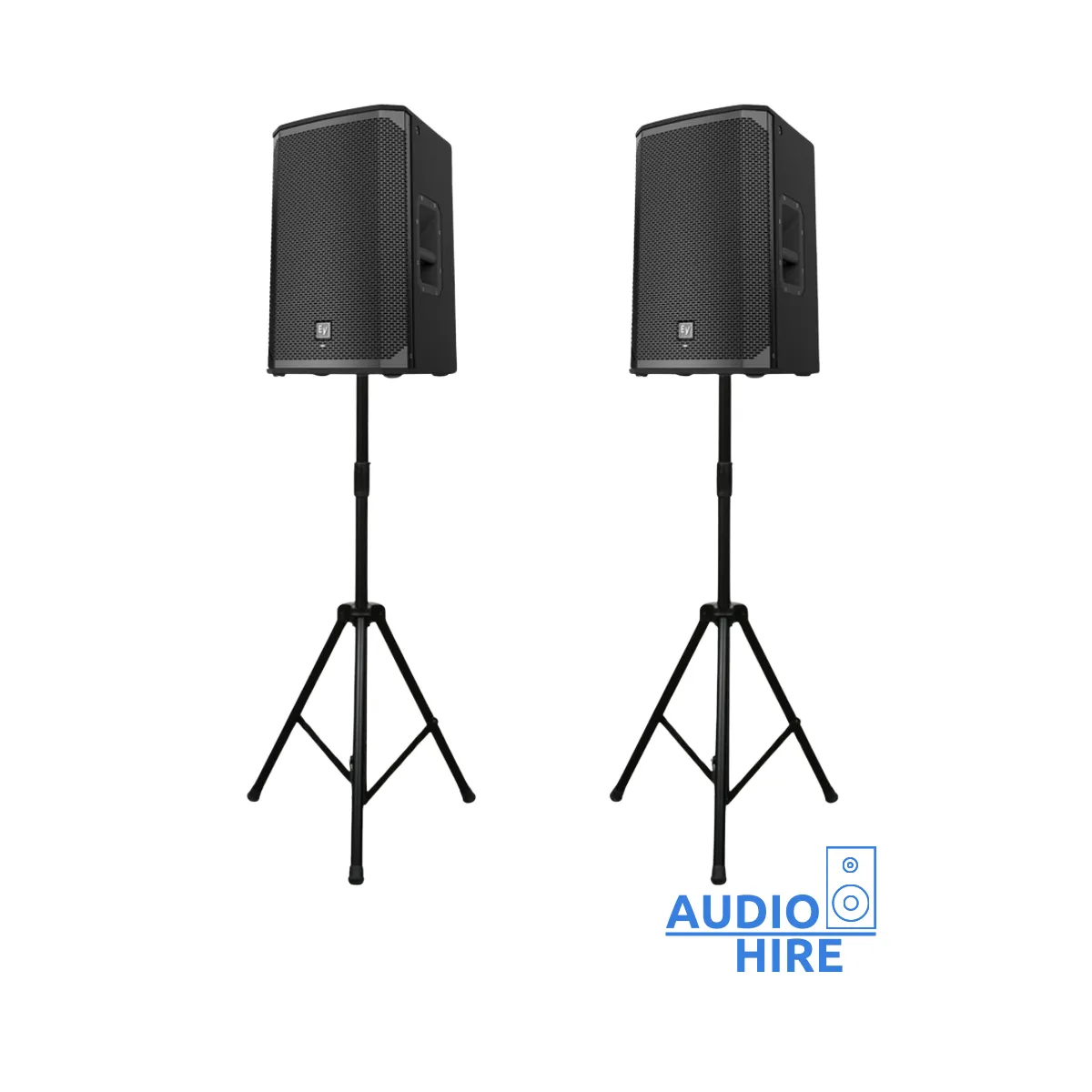
The 2 X 1000 Watt Speaker Package is a straightforward option for smaller applications such as presentations, speeches, announcements and wedding ceremonies. It includes two Electro-Voice ZLX 12-inch powered speakers, two speaker tripods and the essential cables for the setup.
For larger events requiring more output, the 2 x 1500 Watt 15” Speaker Package provides a larger speaker option. The choice should be based on the venue and the event rather than simply selecting the largest system available.
Weddings
Wedding audio can vary considerably depending on what needs to be covered. A ceremony may require a pair of speakers for music and microphones, while a reception may require a larger system if there will be dancing and higher-volume music. If the ceremony and reception are in different areas, consider each location separately because the appropriate system may be different for each part of the day.
Microphone requirements are also important for weddings because poor speech audio can be difficult for guests to tolerate. You can explore the available options through Microphone Hire Adelaide and the wider range of event equipment hire.
Corporate events
Corporate events often prioritise coverage and speech clarity rather than sheer output. A pair of professional powered speakers can be suitable for many presentations, meetings and smaller conferences, while larger rooms or events with audiences spread over a greater area may require a more substantial setup.
The number of microphones and other audio sources is also important. A conference with several presenters and audience Q&A may require additional equipment even if the speaker requirement itself is relatively modest. When planning corporate audio, consider the entire running order rather than looking only at audience numbers.
Parties and birthdays
Parties tend to place greater demands on a speaker system because music may be played louder and for longer periods. A smaller private party may work well with a pair of powered speakers, while a larger venue or music-focused event may require a system with greater output and headroom.
If the event is primarily about dancing and music, consider whether you also need subwoofers rather than simply adding more full-range speakers. The 5600w EV Speaker and Subwoofer Package combines full-range speakers with dedicated low-frequency reinforcement for events where stronger bass and higher output are required.
DJs and live music
DJ events and live music generally require more output than speech-focused events. A DJ playing dance music may benefit from dedicated subwoofers, while a live band can require additional microphones, mixer inputs and monitoring as well as the main speakers.
If a DJ is performing, establish exactly what the DJ is providing before hiring equipment. Some DJs provide their own complete sound system, while others expect the organiser or venue to provide speakers. Confirm who is supplying the speakers, subwoofers and other essential equipment so you don’t end up paying for duplicate equipment or discovering that something important is missing.
For larger music-focused events, the 5600w EV Speaker and Subwoofer Package provides two full-range speakers and two subwoofers in one larger configuration.
Does a bigger venue mean you need more speakers?
Not necessarily. The size of the room matters, but speaker performance, placement and the way the audience is distributed matter as well. A long, narrow room can create different coverage requirements from a wide room with the same floor area. An outdoor audience can also be spread over a much larger distance than an indoor audience.
Instead of simply adding speakers because the venue is large, consider where the audience will be located and whether the sound needs to reach areas further away from the main speakers. In some situations, a better-positioned pair of speakers can provide more useful coverage than adding equipment without considering the overall system design.
Speaker placement matters
Where speakers are positioned can have a major effect on how evenly the audience hears the system. For many events, speakers are positioned at the front of the audience and elevated using speaker stands. Raising the speakers helps project sound over the audience rather than having the sound blocked by people near the front.
Speaker Tripods are available for compatible speaker setups. For larger spaces, additional coverage may be required, but simply placing more speakers around a venue isn’t necessarily the best solution. Placement and configuration should always be considered as part of the overall system.
Do you need more speakers or a bigger system?
These aren’t always the same thing. If an event requires more coverage, additional speaker positions may be appropriate. If the event requires more volume, greater headroom or stronger bass, a larger speaker system or subwoofers may be more appropriate.
For example, moving from a smaller pair of speakers to the 2 x 1500 Watt 15” Speaker Package may make more sense for a larger event than simply adding equipment without considering the overall system. The choice should be based on what the event actually requires.
When do you need subwoofers?
Subwoofers are designed to reproduce the lower frequencies of music and can make a significant difference to a music-focused event. They aren’t normally necessary just because an event has a large audience.
For speeches, presentations and background music, full-range speakers may be sufficient. For DJs, dancing, live music and larger parties, subwoofers can provide the additional low-frequency output needed for a more powerful system. The 5600w EV Speaker and Subwoofer Package is designed around this type of higher-output application.
Indoor versus outdoor events
Outdoor events can require more careful planning because there are no walls or ceilings to contain the sound. An outdoor audience may also occupy a much larger area, meaning the distance between the speakers and the furthest listeners becomes important.
Think about the size of the actual audience area rather than just the total event site. A large outdoor venue doesn’t necessarily need a huge system if the audience is concentrated in a smaller area. Conversely, a relatively modest number of people can require a more substantial setup if they are spread over a large space.
What about microphones?
The number of speakers is only part of the audio system. If the event includes speeches, presentations or announcements, you also need to consider how many people will need microphones.
For a straightforward speech, a Shure SM58 microphone may be appropriate. Where presenters need to move around, the Shure BLX24/SM58 wireless handheld microphone system provides a wireless option. For multiple microphones and other audio sources, you may also need a mixer.
You can see the full range through Microphone Hire Adelaide.
Don’t forget speaker stands and cables
The speaker count isn’t the only thing that needs to be planned. Speaker stands can help position the speakers at an appropriate height, while cable length needs to be considered based on the venue layout.
Standard IEC power cables and speaker cables required for the speaker setup are included with speaker hire from Audio Hire. Longer cables are available where additional reach is required.
A simple way to work out your speaker requirements
Before choosing equipment, think about the event as a whole. How many people actually need to hear the system? Where will the audience be located? Is the event indoors or outdoors? Is the system mainly for speech, background music, recorded music, a DJ or live performance? How loud does it need to be? Are there additional requirements such as microphones, mixers or subwoofers?
Once these questions are answered, choosing the appropriate speaker configuration becomes much easier. Guest numbers provide a useful starting point, but they shouldn’t be the only factor used to select a system.
So, how many speakers should you hire?
For many straightforward events, the starting point will be a pair of speakers. Smaller presentations, wedding ceremonies and private functions may be well suited to the 2 X 1000 Watt Speaker Package, while larger events may benefit from a higher-output pair such as the 2 x 1500 Watt 15” Speaker Package.
For high-energy music events, DJs and events where strong bass and substantially higher output are required, a system such as the 5600w EV Speaker and Subwoofer Package may be more appropriate.
There is no universal guest-to-speaker formula. The right system is the one that provides suitable coverage and output for the particular event.
Need help choosing the right speakers?
If you’re organising an event in Adelaide and aren’t sure how many speakers you need, you don’t have to work out the technical specification yourself. Give Audio Hire the event date, venue, approximate audience size and a description of what will happen during the event. Let us know whether it is indoors or outdoors, whether there will be speeches, music, a DJ or live performers, and how large the audience area will be.
From there, Audio Hire can help you work out an appropriate speaker setup.
Browse Speaker Hire Adelaide, explore PA Hire Adelaide, or browse the full range of sound system hire options.
If you’re ready to book, you can browse the equipment and book online.