.AHLogo1200x1200Black-07578d9b18173fee3d04bf845fdf5007eba8c3c451a934328392e5221830e241.png)
Good speakers are only part of getting good sound at an event.
Where you put them, how high you position them, how you connect them and how you set the levels can make a noticeable difference to what the audience hears.
Audio Hire’s main speaker range is Electro-Voice, including powered speakers and larger EV speaker and subwoofer systems. That means the equipment is designed to be relatively straightforward to use without a separate amplifier rack, but there are still a few things worth getting right.
Here’s how to approach an Electro-Voice speaker setup for a wedding, party, corporate event, presentation or live performance.
Start with the audience, not the speakers
Before unpacking anything, look at the space you’re trying to cover.
Where will the audience be?
Where will people be speaking or performing?
Where is the dance floor?
Where will the DJ, band or presenter be located?
These questions are more important than simply deciding where the speakers look best.
The objective is to distribute sound across the area where people will actually be listening.
Use two speakers where appropriate
For many events, a stereo pair of speakers provides a much better starting point than trying to make one speaker cover everything.
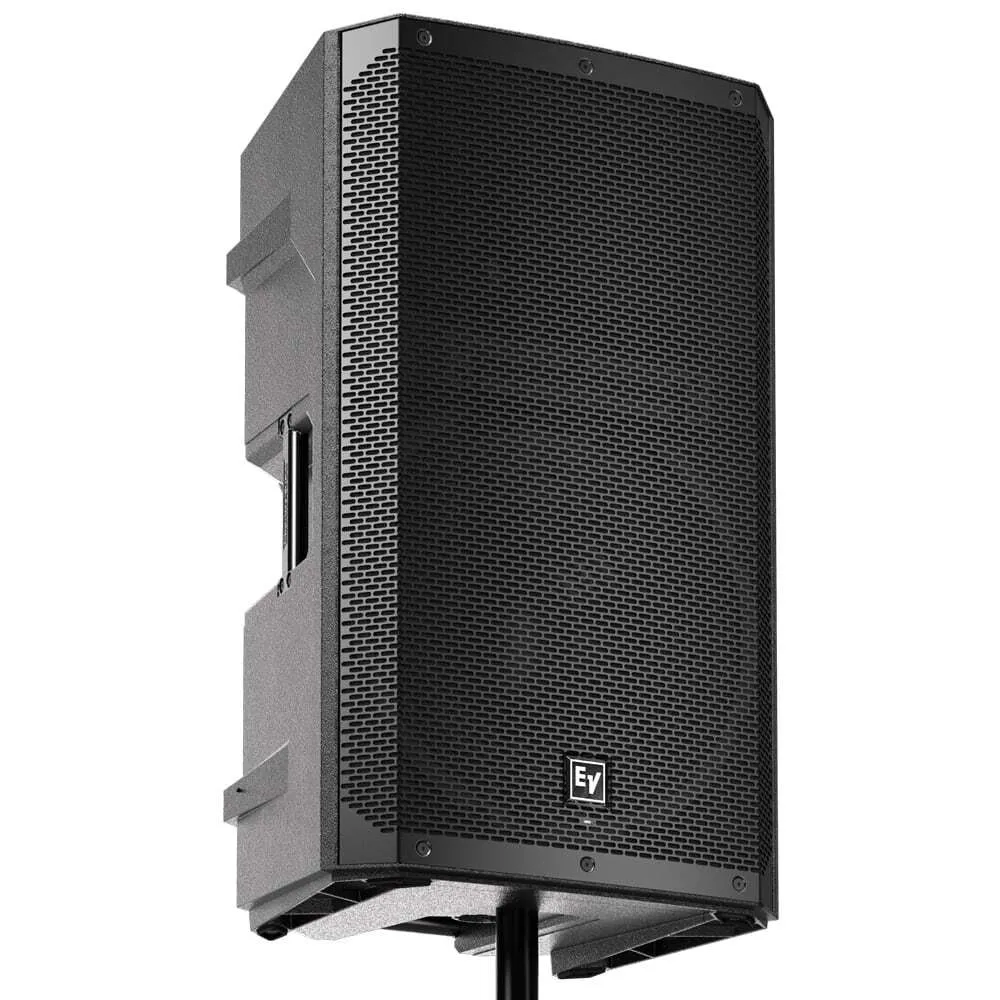
Audio Hire’s 2 × 1500 Watt 15” Speaker Package, for example, consists of two Electro-Voice EKX-15P powered speakers supplied with two speaker stands and two speaker cables.
The two speakers can be positioned on opposite sides of the area you’re covering, providing a more even spread of sound and maintaining stereo information in music.
This is particularly useful for weddings, parties and performances where the audience is spread across a reasonably wide area.
Put the speakers in front of the audience
The main speakers should generally be positioned at the front of the audience area and directed towards the people listening.
Avoid placing speakers behind the microphones.
If a microphone is positioned between the speaker and the audience, the microphone can pick up sound coming from the speaker and feed it back into the system.
That is one of the easiest ways to create feedback.
For speeches and presentations, keeping the microphones behind the main speaker line is particularly important.
Raise the speakers above the audience
Speaker stands aren’t simply there to make the setup look professional.
Raising the main speakers helps the sound travel over the heads of people near the front of the audience.
If a speaker is sitting on the floor or at head height, people immediately in front of it can block a significant amount of the sound from reaching people further back.
Putting the speakers on suitable stands provides a clearer path into the audience.
Audio Hire supplies speaker stands with the 15-inch speaker package, and speaker stands are also available separately.
Aim the speakers at the audience
Once the speakers are at an appropriate height, angle them towards the area you’re trying to cover.
Don’t automatically point both speakers straight ahead.
Look at the shape of the audience area.
If people are spread across a wide room, you may need to angle the speakers slightly outwards.
If the audience is concentrated in a narrower area, the speakers can be aimed more directly into that space.
Small changes in positioning can sometimes make a bigger difference than simply turning the volume up.
Keep the speakers away from walls and corners where possible
The exact positioning depends on the venue, but avoid pushing the main speakers unnecessarily far into corners.
Walls and corners can affect the way low frequencies build up in a room.
They can also make it harder to achieve even coverage.
For a typical event, positioning the speakers towards the front of the room, raised on stands and aimed into the audience is a sensible starting point.
Connect the equipment before turning it on
Powered Electro-Voice speakers have their amplification built into the cabinet, so you don’t need a separate power amplifier.
You do, however, need to connect the audio source correctly and provide mains power.
A typical signal path might be:
Microphone or music source → mixer → powered speakers
For a simple setup, the mixer may not even be necessary if the source can be connected directly to the speakers.
For an event involving several microphones, music playback or multiple audio sources, a mixer provides much more control.
Audio Hire’s Speaker Hire Adelaide range includes speaker systems as well as the microphones, mixer and other equipment that can be added where required.
Don’t forget the cables
The cables are part of the system.
Audio Hire includes the standard speaker cables and IEC power cables required for its speaker setups.
If your venue requires longer cable runs, longer power and speaker cables are also available as optional extras.
Think about the physical layout before you start running cables.
The mixer might be at the side or rear of the room while the speakers are at the front. A microphone might need to travel some distance to a presenter or performer.
Planning those cable runs beforehand makes the final setup much cleaner.
Set the speaker levels carefully
Once everything is connected, resist the temptation to immediately turn everything up.
Start with the levels down.
Play your normal music source or speak into the microphone and gradually bring the system up to the required level.
Listen for distortion and watch the relevant level indicators.
The objective isn’t to make the speakers as loud as possible.
It’s to achieve the required volume while keeping the system clean and controlled.
For a more detailed explanation of gain staging and setting levels, Audio Hire has a separate guide to setting up a hired mixer and speakers.
Setting up for speeches
Speech requires a slightly different approach from music.
The priority is intelligibility.
People at the back of the room need to understand every word without the people at the front being subjected to excessive volume.
Position the speakers so they cover the audience evenly, and keep microphones behind the speaker line.
If you’re using a handheld microphone, encourage the speaker to keep the microphone reasonably close to their mouth.
If you’re using a wireless microphone, the same principle applies.
And don’t overlook wired microphones.
For a straightforward speech or presentation, a wired microphone such as the Shure SM58 can be an excellent option. Wireless isn’t automatically better; it simply provides freedom of movement.
Audio Hire offers both wired and wireless microphone hire in Adelaide.
Setting up for a wedding
Wedding audio often needs to perform several different jobs.
The ceremony might require microphones and modest background music.
The reception may involve speeches and announcements.
Later in the evening, the same main PA may be used for music and dancing.
Think about the entire event when positioning the equipment.
If the ceremony and reception are in different locations, the most appropriate setup may also be different.
For a reception with a DJ and a busy dance floor, a larger system may be appropriate.
You can read more about wedding audio hire in Adelaide when planning the complete sound requirements.
Setting up for a DJ
A DJ setup usually has different requirements from a presentation.
The DJ’s controller or mixer becomes the audio source feeding the PA.
The main speakers should be positioned to cover the audience and dance floor, while the DJ needs to be able to monitor their own output.
For larger or higher-energy events, dedicated subwoofers can add substantial low-frequency output.
Audio Hire’s 5600W EV Speaker and Subwoofer Package combines two full-range speakers with two 18-inch subwoofers for events where additional low-frequency reinforcement is required.
Setting up for live music
Live music requires more planning because the PA may be handling several microphones and instruments simultaneously.
The mixer becomes the central point for controlling the different sources.
The main speakers should be positioned in front of the performers and audience, while any stage monitoring needs to be arranged so performers can hear what they need without creating unnecessary feedback problems.
The size and complexity of the system will depend on the number of performers, venue and style of music.
A solo acoustic performer and a full band shouldn’t be treated as the same PA requirement.
Setting up EV speakers with subwoofers
If you’re using full-range EV speakers with dedicated subwoofers, the positioning becomes more important.
The subwoofers handle the lower frequencies while the main speakers reproduce the rest of the program.
Audio Hire’s larger EV system uses two full-range speakers and two 18-inch subwoofers.
For a music-focused event, this configuration provides a much more substantial low-frequency foundation than simply increasing the volume of the main speakers.
If you’re trying to decide whether your event needs this type of system, see How Many Subwoofers Do I Need for My Event?.
Do a soundcheck before guests arrive
Don’t wait until the first speech or the first song to discover that something isn’t working.
Allow time to test the system before the audience arrives.
Play music through the system.
Test every microphone.
Check that the DJ or other audio source is connected correctly.
Walk around the audience area and listen from different positions.
If there are speeches, have someone stand where the audience will be and listen to the microphone from there.
A few minutes of testing can reveal problems that aren’t obvious when you’re standing beside the mixer.
Walk around the room
One of the easiest mistakes is judging the sound from directly beside the speakers.
That’s not where most of your audience will be.
Walk around.
Listen near the front.
Listen in the middle.
Listen at the back.
Listen at the sides.
You’re looking for reasonably consistent coverage rather than one particular spot that sounds exceptionally loud.
If the back of the room is too quiet, turning the entire system up may make the front uncomfortably loud.
Changing the speaker position or adding appropriate coverage can sometimes be a better solution.
Don’t put the speakers too loud
More volume isn’t always better.
Excessive volume can make speech harder to understand and music tiring to listen to.
It can also create additional problems with microphones and feedback.
The right level is the one that allows the audience to hear comfortably and clearly.
For a wedding speech, that’s very different from the level you might want on a dance floor.
When should you consider delivery and setup?
A straightforward speaker hire can be relatively easy to collect and set up yourself.
Larger systems become progressively more difficult to transport and assemble.
If you’re dealing with multiple speakers, subwoofers, microphones, mixers and other equipment, delivery and setup can save considerable time and effort.
Audio Hire offers delivery and collection across Adelaide, with setup options available for suitable bookings.
For more complicated productions, technical support may also be appropriate.
The simplest setup isn’t necessarily the smallest setup
A common assumption is that the best event setup is the one with the fewest pieces of equipment.
That’s not always true.
A pair of properly positioned speakers on stands can produce a much better result than one speaker sitting on a table.
A mixer can make several microphones and audio sources considerably easier to manage.
A subwoofer can improve a music-focused system without requiring you to push the main speakers harder.
The objective is to use the equipment that solves the actual problem.
Need help setting up your Electro-Voice system?
You don’t need to work everything out before hiring.
Tell Audio Hire what you’re organising, where the event is being held, approximately how many people will attend and what you need the sound system to do.
We’ll help you work out an appropriate setup.
If you already know what you need, browse Speaker Hire Adelaide, choose your dates and book online.
More Electro-Voice information
This article is part of the Audio Hire Electro-Voice resource.
As the EV resource develops, you’ll be able to explore individual speaker guides, comparisons, subwoofer information and practical advice for using Electro-Voice equipment at different types of events.