.AHLogo1200x1200Black-07578d9b18173fee3d04bf845fdf5007eba8c3c451a934328392e5221830e241.png)
If you’ve been comparing PA speakers, you’ve probably noticed that wattage gets a lot of attention.
1,000 watts. 1,500 watts. 3,000 watts. 5,600 watts.
It can be tempting to assume that the speaker with the biggest number must be the loudest or the best choice.
It isn’t that simple.
Speaker wattage is useful information, but wattage alone doesn’t tell you how loud a speaker will be, how well it will cover an audience or whether it’s the right PA for your event.
So what does speaker wattage actually mean?
What is speaker wattage?
Wattage is a measurement of electrical power.
With powered speakers, the amplifier is built into the speaker cabinet, so the amplifier’s power rating is often expressed in watts.
You might see specifications describing amplifier power as continuous power, RMS power or peak power. These terms aren’t interchangeable, and manufacturers don’t always present their specifications in exactly the same way.
That’s one reason comparing speakers simply by looking at the largest wattage number can be misleading.
More watts doesn’t automatically mean more volume
This is probably the most important thing to understand.
A speaker rated at 1,500 watts isn’t necessarily twice as loud as one rated at 750 watts.
In fact, doubling amplifier power represents only around a 3 dB increase under idealised conditions. The relationship between electrical power and perceived loudness isn’t as straightforward as the numbers might suggest.
Other parts of the loudspeaker design have a major influence on its actual output, including speaker sensitivity, driver efficiency, maximum SPL, amplifier design, enclosure design, DSP and thermal limitations.
So when you’re choosing a PA, wattage should be considered alongside the other specifications.
Why do speaker manufacturers quote different wattages?
There isn’t one universally used way of presenting amplifier power.
One manufacturer might prominently advertise a peak figure. Another might emphasise continuous power. Another might use a combined figure for multiple amplifier channels.
This can make direct comparisons confusing.
For someone hiring a PA, the most useful question isn’t “Which speaker has the most watts?”
It’s “Which system has enough output and headroom for my event?”
That distinction can save you from hiring equipment that is either unnecessarily large or simply not suited to what you’re trying to achieve.
What is RMS power?
RMS is commonly used as a way of describing continuous power or power handling.
However, the precise way manufacturers use and publish power specifications can vary.
This is why it’s important to look at the complete specification rather than assuming every manufacturer’s wattage figure was measured in exactly the same way.
For practical event hire, specifications such as maximum SPL, frequency response and the intended application can often tell you more about a system’s suitability than a headline wattage number.
What is peak power?
Peak power refers to the maximum power associated with short-term peaks rather than sustained operation.
Music contains peaks and transients, so a speaker may be capable of handling significantly more power for a short period than it can continuously.
Peak figures can therefore look impressive.
But they aren’t particularly useful if you’re trying to work out whether a speaker is suitable for a three-hour event.
When comparing PA systems, be careful about treating peak wattage as though it represents continuous real-world output.
What does 1,000 watts mean for a PA?
A 1,000-watt powered speaker isn’t necessarily a “1,000-watt loudspeaker” in the simplistic sense.
The wattage describes the amplifier power associated with the system. The actual acoustic output depends on how effectively the speaker converts that electrical power into sound.
This is why two powered speakers with similar amplifier ratings can have different maximum SPL specifications.
For event hire, the important question is whether the complete speaker system can provide enough output and headroom for the application.
What does 1,500 watts mean?
Audio Hire’s 2 × 1500 Watt 15” Speaker Package provides a useful example of why wattage needs context.
The package consists of two Electro-Voice EKX-15P powered speakers.
The package’s headline wattage is useful as a simple way of identifying the system, but it doesn’t tell you everything about what the system can do.
The speaker’s driver, amplifier, enclosure, DSP and maximum SPL all contribute to its performance.
You can read more about the Electro-Voice EKX-15P if you’re considering the 15-inch EV option for an event.
What about a 5,600-watt system?
The same principle applies to larger systems.
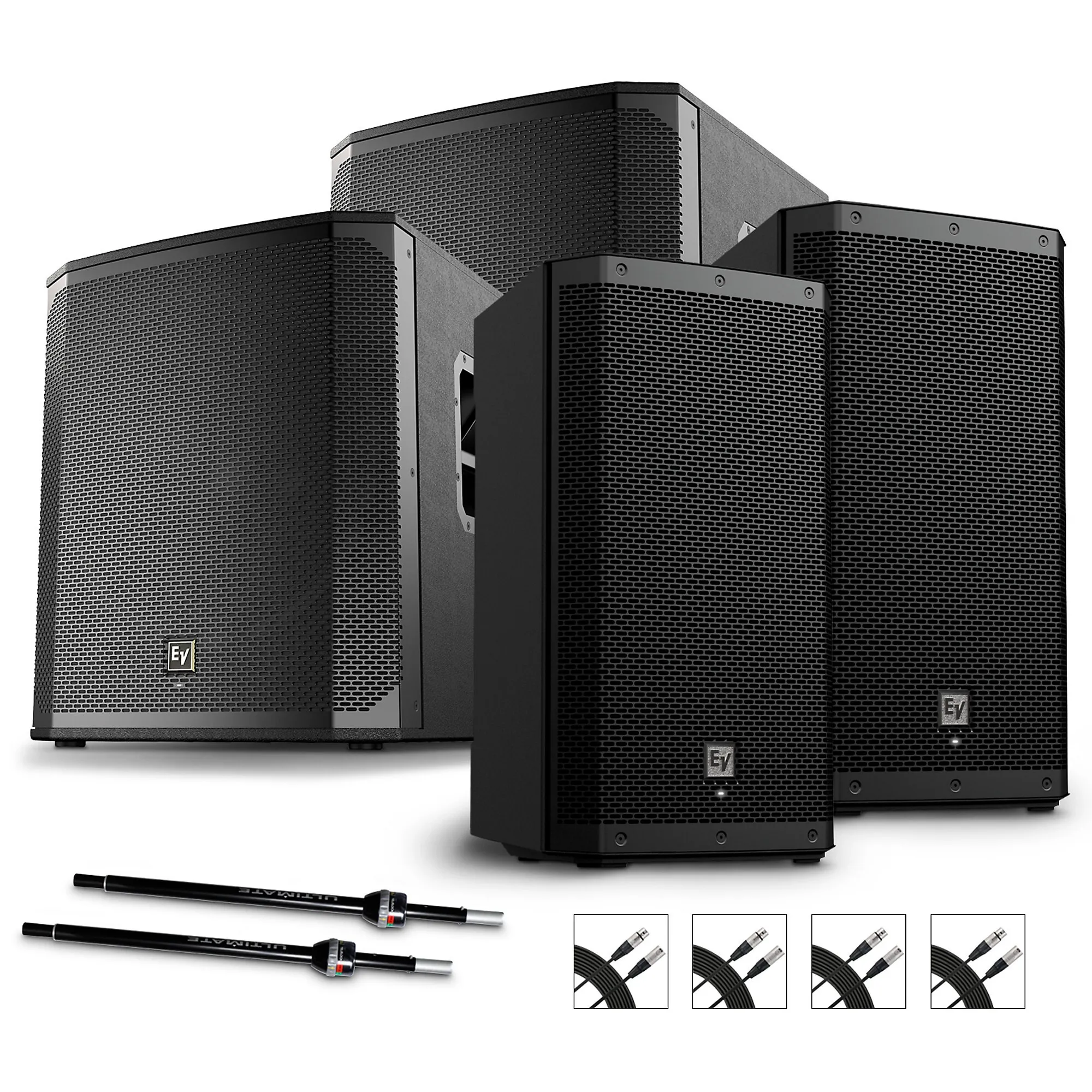
Audio Hire’s 5,600-watt EV speaker and subwoofer system combines multiple loudspeaker components, including dedicated subwoofers.
The headline wattage represents the combined system rather than the output of a single speaker.
And again, 5,600 watts doesn’t mean the system is automatically appropriate for every event.
A small presentation doesn’t become better because you bring a much larger PA.
The system needs to match the job.
What is maximum SPL?
Maximum SPL is often a more useful specification when you’re trying to understand how much acoustic output a speaker can produce.
SPL stands for Sound Pressure Level and is measured in decibels, or dB.
Unlike amplifier wattage, maximum SPL describes the acoustic output capability of the speaker.
This is one reason it can be more useful when comparing the practical output of different PA speakers.
However, even maximum SPL needs context. Manufacturers can use different test methods and conditions, so it isn’t always a perfect apples-to-apples comparison either.
Wattage vs SPL
A simple way to think about it is that wattage tells you about electrical power, while SPL tells you about acoustic output.
Neither number tells the entire story.
When choosing a PA, you should consider the complete system. Frequency response tells you about the range of frequencies the speaker can reproduce. Coverage tells you how widely it distributes sound. Driver configuration, enclosure design and DSP all contribute to the final result.
This is why a speaker with a lower advertised wattage can sometimes outperform a speaker with a higher advertised wattage in a particular application.
Does a 15-inch speaker need more watts?
Not necessarily.
A larger low-frequency driver may have different power requirements and performance characteristics from a smaller one, but driver size and amplifier wattage aren’t directly interchangeable.
If you’re trying to decide between 12-inch and 15-inch speakers, it’s better to consider the type of event, required output and amount of low-frequency energy rather than simply choosing the speaker with the bigger number.
How much wattage do I need for my event?
This is where things get more useful than simply looking at specifications.
There is no reliable rule such as “100 people equals 1,000 watts” or “200 people equals 2,000 watts.”
Event audio doesn’t work that neatly.
The required system depends on the audience size, venue, whether the event is indoors or outdoors, the type of music, desired volume, amount of speech, stage layout, speaker placement and whether subwoofers are being used.
A 100-person presentation and a 100-person dance party can have completely different PA requirements.
Wattage for speeches and presentations
For speech-focused events, maximum power isn’t necessarily the priority.
You want clear, intelligible voices distributed evenly across the audience.
That means speaker placement, microphone selection, room acoustics and system configuration can be just as important as amplifier power.
A relatively compact PA can perform extremely well for a presentation.
If you need microphones as well, explore Microphone Hire Adelaide.
Wattage for weddings
A wedding may need different levels of PA throughout the day.
A ceremony might require clear speech and background music. A reception may require a more substantial system for music and dancing.
If you’re hiring a PA for a wedding, consider the different parts of the event rather than choosing the biggest wattage available.
Our Wedding Audio Hire guide looks at the broader equipment requirements for wedding ceremonies and receptions.
Wattage for DJs
DJs generally place greater demands on a PA than speech-only events.
Music can contain significant low-frequency energy, and a dance floor needs the system to maintain useful output at higher levels.
This is where the overall system design becomes particularly important.
For some DJ events, a pair of full-range speakers may be appropriate. For larger or higher-energy events, dedicated subwoofers may provide the additional low-frequency output required.
You can explore Audio Hire for DJs in Adelaide to see how the requirements change depending on the event.
Wattage for live music
Live music adds another layer of complexity.
The PA may need to reproduce vocals, guitars, keyboards, drums, bass and playback, while also providing enough headroom for changes in performance level.
The number of performers, venue and desired volume all affect the system requirements.
A small acoustic performance doesn’t need the same PA as a full band performing to a large audience.
Why headroom matters
Headroom is the amount of capacity a system has beyond its normal operating level.
It matters because you don’t want a PA operating at its absolute limit throughout an event.
A system with sufficient headroom can reproduce peaks and changes in the program more comfortably. This can help the system sound cleaner and more controlled.
So when choosing between two systems, don’t only ask which has the biggest wattage number.
Ask which system gives you enough usable output and headroom for the event.
Should you always hire the biggest PA?
No.
More equipment isn’t automatically better.
A large PA can mean more equipment to transport, more equipment to set up, more space required, higher hire costs and more complexity.
If the event doesn’t require the additional output, a smaller system may be the better choice.
The objective is to have enough PA — not the most PA.
What should you look at instead of wattage?
When comparing speakers, look at the complete specification.
Maximum SPL can tell you about potential acoustic output. Frequency response provides an indication of the range of frequencies the speaker can reproduce. Coverage tells you how widely sound is distributed.
Driver configuration, amplifier design, enclosure design and DSP also contribute to the performance of the finished loudspeaker.
Perhaps most importantly, consider the application the speaker was designed for.
A compact speaker designed for portable presentations and a large speaker designed for high-output music may have completely different priorities.
The practical way to choose a PA
Instead of starting with wattage, start with your event.
What are you doing? How many people are there? Where is it happening? Is it mainly speech, music or both? Is there a dance floor? Is there a DJ or live band? How important is bass?
Once those questions are answered, the appropriate equipment becomes much easier to determine.
This is also why Audio Hire focuses on matching equipment to the event rather than simply recommending the highest-powered option.
Need help choosing your speakers?
You don’t need to become an expert in speaker specifications before hiring a PA.
Tell Audio Hire what you’re planning, where the event is being held and what you need the system to do.
We’ll help you choose an appropriate setup rather than simply pointing you towards the speaker with the biggest number on the specification sheet.
Or browse Speaker Hire Adelaide to see the current speaker options and book online.
More Electro-Voice information
This article forms part of the Audio Hire Electro-Voice resource.
The Electro-Voice Speakers Adelaide pillar page will provide the central starting point for the EV range, with supporting articles covering speaker selection, speaker size, subwoofers, setup and different event applications.
As the EV resource grows, these supporting articles will give you practical information about choosing and using the equipment rather than simply listing specifications.